Showing posts with label Review. Show all posts

2009/08/24

People Should Be Beautiful...In Their Thoughts and in Their Innermost Selves


Cold Souls - (2009) Directed by Sophie Barthes;

Starring Paul Giamatti, David Strathairn,

Dina Korzun, and Emily Watson


It starts with Chekhov's Uncle Vanya as recited by actor Paul Giamatti who in the film, as himself, is playing the title role. Its a very powerful opening for lo-fi sci-fi comedy/drama, Cold Souls. I am unfamiliar with Uncle Vanya so it took me a moment to realize Paul's words were that of the play and not his own. Though I feel this was intentional, as even Paul admits that he cannot separate himself from the character he's playing (Voynitsky "Vanya"), thus feeling as the character does in the play, as if his soul is weighing him down. The story was well-written and directed by Sophie Barthes who makes her full feature film debut. Both New York and Russia are beautifully represented and the consistent unfocusing of the camera lens throughout the film gave one the impression of lost perspective, of a reality blur that at one lovely shot of an almost translucent Dina Korzon walking through a New York Night, she became as Aldous Huxley's Denis once wrote of the soul, "pale, tenuous membrane." The film is cold and lonely with a sense of solidarity between the characters, who are each convincing under such fantastic premises as soul extraction and soul trafficking, (which I promise you, if the first were possible, the latter would be sadly but most definitely inevitable).


I add this literal "soul searcher" film to such films as Stranger Than Fiction, Eternal Sunshine of the Spotless Mind, Being John Malkovich, and others I might have missed or are yet to come, where realistic drama is introduced to an incredible plot drive whose technical function isn't really explained and such an explanation remains unessential to the core of the story which is mainly focused on how the characters deal out their problems through this plot device (i.e., a soul extracting machine, a memory erasing clinic, a narrator who narrates your life, a portal into John Malkovich's mind).


Eternal Sunshine of the Spotless Mind's Lacuna Inc. and Cold Souls' Soul Storage were vehicles for temporarily stripping the main characters' problem through an immediate, unrealistic solution that only brought forth more problems for the protagonists. Of the films I mentioned, Eternal Sunshine is the one most related to Cold Souls.


These stories remind me of the science fiction of author, Philip K. Dick, who spent more time on the people in his stories than the machinery of the future they usually occupy. The main characters in his novels were typically the little guy, the person at the bottom who didn't have anything to gain from the world he lived in. Its rather a shame or crime that most of the films adapted from Dick's work fails to capture the same human feeling when compared to any of the films mentioned above. Paul GIamatti has been mentioned to portray Philip K. Dick in a possible bio-pic but I hope someone has enough sense to get someone with at least half the imagination of Charlie Kaufman, Sophie Barthes, or Dick himself to handle the story.


(note to self: read Uncle Vanya)

2009/08/15

Keep it Reel, Son!: Introduction and Review

I've been watching a lot of films lately. In fact, every week I watch at least three films I've never seen before. It has recently been an idea of mine to log each film I view. The films can range from any era, from movies currently in theatres to 1920's silent films to everything in between; in any language from any country. This entry is a quick wrap-up of the last two weeks but from now on I will log each film I watch on the same day its viewed.

The Best Man -
(1964) Directed by Franklin J. Schaffner; Starring Henry Fonda and Cliff Robertson both as presidential candidates. Uncle Ben Parker wasn't using his great powers responsibly in this morality film, he was really intense actually. Its a good film about corruption in politics and how the best man is often over-looked due to his image. Hmm. Ron Paul.


The Wrong Man -
(1956) Directed by Alfred Hitchcock; Starring Henry Fonda and Vera Miles as a married couple that undergoes trouble when his identity is mistaken and he is arrested for a crime he is innocent of. Hitchcock, so its suspenseful but its also based on a true story so I get really touchy when the cops foul-up. When Manny (Henry Fonda) gets arrested and they don't allow him to tell his wife even though he's right outside his home, I nearly wanted to blow up a precinct.


Barton Fink -
(1991) Directed by Joel Coen; Starring John Turturro and John Goodman in this dark film about an intellectual new york playwright in hollywood who undergoes events that may very well be over his head but incidently what he was looking for in the first place. I feel like this and Miller's Crossing which I viewed for the first time only last month, are two secret masterpieces by The Coen Brothers. Both films are dark and quiet, Barton Fink is a bit more exploring and uses symbolism to further illustrate the protagonist's mind and perhaps its deterioration.


Mr. Blandings Builds His Dream House -
(1948) Directed by H.C. Potter; Starring Cary Grant and Myrna Loy. Cary Grant in a screw ball comedy about a city family that moves out to the suburbs. Cary Grant as victim and butt of the jokes much like in Bringing Up Baby and I Was a Male War Bride. I however, did not enjoy this film as much as the other two aforementioned comedies, it wasn't as mature as the gags that fell upon both David Huxley via Katherine Hepburn or Capt. Henri Rochard via Ann Sheridan. The script isn't as rich either. I understand its a comedy and meant to be fun but I don't think it aged too well, I guess thats why Bringing Up Baby bombed when it made its debut in theatres but is now regarded as a classic of comedies.


The Americanization of Emily -
(1964) Directed by Arthur Hiller; Starring James Garner and Julie Andrews. A war picture thats not on the warfield for 95 percent of the film and follows the religiously cowardice enterprise of Lt. Cmdr. Charles Edward Madison played by Garner. I can't help but like James Garner and this is the first film I've seen Julie Andrews in. It might come across as too preachy but its well rounded and I felt everyone got a word in, it wasn't just one view shoved down your throat. Also all the points were valid and still are, especially about war and the glory of patriotism.


Mister 880 -
(1950) Directed by Edmund Goulding; Starring Burt Lancaster and Dorothy McGuire. NY Secret Agent, Steve Buchanan (Lancaster) Tracks a counterfeiter, Mister 880. I wasn't too crazy about this film but Burt Lancaster is always fun to watch. Also Skipper is how I'm most likely going to end up in about 40 years.


The Seven-Ups -
(1973) Directed by Philip D'Antoni; Starring Roy Schieder. Were the 70's action movies all about car chases? This action crime movie had a really good car chase, pretty long and epic, one got the impression the entire movie was only an excuse for that one scene. It was also great to see NY in the 70's, some of the locations were grimey. Oh, and I removed the color from my TV set just to watch this movie in B/W which as far as I'm concerned is the only way to watch it.


So Long At The Fair -
(1950) Directed by Antony Damborough and Terence Fisher; Starring Jean Simmons and Dirk Bogarde. Mystery/Suspense set in 1890's Paris. A young Dirk Bogarde. I can't get over his life-long resemblence to author, Aldous Huxley. I kept imagining Crome Yellow's Denis or Walter Bidlake whenever George Hathaway (Bogarde) was on screen. The film was decent enough but I found myself ultimately not a fan. The suspense was good and the mystery kind of disappointing.


Notorious -
(1946) Directed by Alfred Hitchcock; Starring Ingrid Bergman and Cary Grant. Cary Grant is a U.S. agent who falls in love with a woman who has been assigned to spy on a group of Nazi friends in South America. Alicia Huberman (Bergman) goes as far as marrying an old friend to report information obtained by her position as his wife, although Huberman loves Agent Devlin (Grant). Tensions rise between the two and so does Hitchcock's suspense as the mission grows more and more dangerous for Bergman's Garbo-esque leading lady. I think this is the first serious role I've seen Cary Grant in. Though, To Catch a Thief is not a comedy, Grant is still charming and suave, in Notorious he is stern and bitingly cold, a side I've never seen before from Grant, need-less-to-say I enjoyed it muchly!


Crisis -
(1950) Directed by Richard Brooks; Starring Cary Grant and Jose Ferrer. Cary Grant as a brain surgeon on a holiday with his wife when they get abducted and forcefully volunteer Dr. Eugene Norland Ferguson (Grant) to perform brain surgery on dictator Raoul Farrago (Ferrer) to save the tyrant's life. I love the music in this film and of course Jose Ferrer but other than that I wasn't too into it. I heard the studio decided to change the script so that Grant could have a love interest, originally Dr. Ferguson was set to be on holiday with his daughter which to me, may've been more interesting. This being Richard Brooks' first film he went along with the studio.


Mr. Lucky -
(1943) Directed by H.C. Potter; Starring Cary Grant and Laraine Day. Comedy with Cary Grant. Same director from Mr. Blandings with a better script. Here Grant plays a fast talking, street-wise hustler who evades the war draft and tries to raise money to get his gambling boat racket off the harbor. How does he do this? Well, he not only tries to con a war relief charity group and partially succeeds by throwing a fund raising, gambling boat party but he also falls in love with one of the directors who slowly begins to trust him. Not to mention that he does all this under the presumed identity of a dead gangster. I really enjoyed this film, here Grant is the charming scoundrel which is quite similar to his mischievous gentleman roles he sometimes played (examples: The Philadelphia Story and The Bachelor and the Bobby-Soxer). except he uses slang and mannerisms that draw the viewer ever so on the side of the happy-go lucky swindler who happens to carry a "Lady from Bristol." My only complaint, and its not a big one, is the ending. I could have done the end one scene before the actual end but its a romantic comedy and I admit I was happy to see all end well.


The Unforgiven -
(1960) Directed by John Huston; Starring Burt Lancaster and Audrey Hepburn. Hepburn is an adopted kid sister to Lancaster who turns out to be of native american blood in this western drama. It was alright. Like I said, I can watch Burt Lancaster in anything, this was even better because Audrey Hepburn is always good to watch as well and as a secret springle of magnificence, Joseph Wiseman has a minor but key role as Abe Kelsey or the "crazy old man" who reveals Hepburn's origin. Joseph Wiseman is so good, I've only seen him in A Detective Story until now. I'd like to see more of his characters.


The Children's Hour -
(1961) Directed by William Wyler; Starring Audrey Hepburn, Shirley Maclaine, and James Garner. I hate kids and this film makes me even less fond of them. Karen (Hepburn) should've punched Mary's stupid little face in. I'm a huge fan of angry Shirley Maclaine, when she yells or cries I instantly feel like apologizing. Karen and Martha (Hepburn and Maclaine) are two teachers who start an all girls' boarding school and have their lives and reputations compromised when a troublesome student spreads a controversial lie about them.

2009/03/06

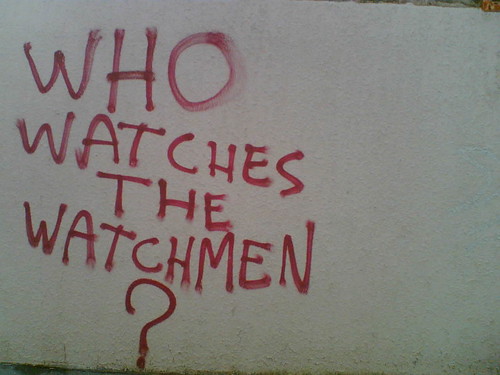
Watching The Watchmen


Just a warning to those who have not read or seen the movie, I do disclose information that may very well spoil the movie for you.

I saw the Watchmen at the first minute of March 6, 2009. Yes, by no plan of mine did I agree to join the movie zealots who could not wait for an actual sun to introduce friday as the opening day. I don't want to fully dress the description of the event only to sharply nake its conclusion, so I'll just tell you I was not impressed.

Maybe I mayn't find the exact qualifications to call myself a fan of The Watchmen but beside the fact that I've only read the graphic novel one and a half times (rather recently may I add); I do read and I do watch films. I immediately loved Alan Moore's creation of an alternate world where costumed heroes exist and the realistic consequences of that factual circumstance. After reading the graphic novel I had to look through it once again, since I was so immersed in the writing that I at times forgot to take in Dave Gibbons' wonderful and classic images and direction. And I knew the movie adaptation would not be able to completely replicate the graphic novel, a medium fully made use of by Moore and Gibbons who stocked their world with history and depth through supplementary material between chapters and further fermented the richness of the plot and theme with The Tales of The Black Freighter, a comic book within the graphic novel that interwove with the events occurring in the story. And while its true that adaptions of written works onto films usually stumble short and shy of its source, there is still something to be said of a well executed screenplay and director who can translate the emotions and atmospheres of the written work and re-establish their counter-part onto film. Zack Snyder did not succeed in accomplishing this.

It is my opinion that sequence leads to consequence, that consequence is made up only of all sequences prior. Everything in the present is the ultimate result of everything that came before it, becoming in itself another sequence for a later consequence. To build the world and story of The Watchmen, which tenses and leads to a sweltering climax, one must carefully plant the sequences. The handling of the subtle information that should collect and cancer itself into the tension of a climax and the release of a resolution must be essentially considered. If executed properly, from the bright glow of the climax, like a mushroom cloud shall the consequence bloom a full, fertile tree. One easily felt bored by the characters and their conflicts, leaving one a bit apathetic and misunderstanding to their reactions. For instance, when Laurie breaks down and cries when John discloses to her that she is infact the daughter of Eddie Blake, The Comedian, her reaction is just as out of place as Dan's when Rorshach is burst apart by Dr. Manhattan. Laurie's hatred for Edward Blake was not emphasized enough for such a reaction nor was the bond between Rorschach and Niteowl (Dan). There was not enough emotional depth to the characters in the movie to validate these passionate outbursts. Rorschach and John were the gems of the movie but even Rorschach's set-up capture at Moloch's apartment and John's interview trailed steam where fire should've blazed. Yet, we were not deprived anything during Dan and Laurie's sex scene aboard Archie. A scene too long and slow for comfort. Immediately recalling Snyder's slow-motion sex scene between King Leonidas and Queen Gorgo in 300. And even though, I could have done without it in 300 it wasn't as crude and awkward as Niteowl and Silk Spectre II piping aboard poor Archimedes in slow motion as if we the audience should savor the visual sensation, which consists of no more than Niteowl and Silk Spectre II's facial and bodily writhing through a cool-blue camera filter.

Regardless of what may've been said of 300 I did enjoy it and still do watch the DVD from time to time. Zack Snyder's style does work depending on what the movie calls for. The slow-motion accents of actions, the color, and the camera direction; these were areas that annoyed me about The Watchmen movie yet coincidently, they were also the points I found interesting in 300. You can't cook a steak the same way you fry an egg, even if you use the same pan.

As I sat there watching the movie I felt stationed somewhere between restless and listless because, having read the graphic novel, I knew what was going to happen and the compensation of an interesting transposition from literature to film did not acquaint. The ending was slightly altered, this I didn't mind; but by failure of the story and direction to carefully present everything that leads us forward to the end in a compelling fashion, did its impact suffer. The Watchmen is a great graphic novel, I don't see why it shouldn't have been a great film. As far as the story, of course its good, could anything else be expected since it follows the graphic novel, only omitting minor details that may be more important than realized. The film definitely wasn't butchered and I believe its only those who, wished for an equivalent department of reverence for the film to board adjacent to the reverence residing on the written work itself, that will be disppointed. And why shouldn't they? No compromise. Unfortunately, this leaves a huge blood stain, like a crimson ink blot on the clear white snow of your impression.